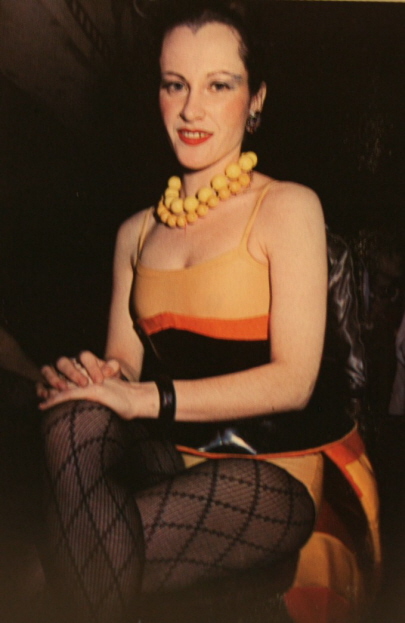
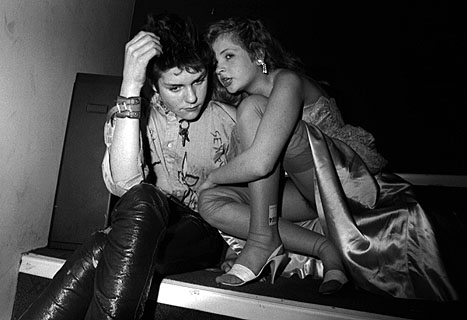
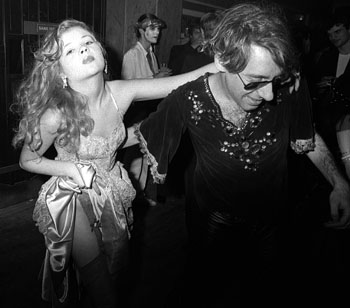
This Dancerie: The Paris Project
Project Description
This Dancerie is a multi-event, multi-site, multi-media work that explores the ways in which gay men have created public expressions of desire despite mainstream prohibitions of manifestations of those aspects of their lives in the context of Paris as a complex historical cultural arena for this exploration.
The pretext of This Dancerie is urbanization as a prerequisite for homosexual subculture and the understanding that despite the absence of “gay ghettos, ” gay men developed and carried on forbidden lives in public it cities around the world. This Dancerie focuses on Paris as a cross-road of queer life in which, although, technically, homosexuality was legal since 1791, decency was legislated and under surveillance.
This Dancerie will create a series of foci on Paris as a site of refuge for queer men and the environments they historically frequented. Particular attention will be placed on developing narratives that include a range of differing intersections of class, race, creeds, ethnicities and gender the collaborators will develop a movement based-work for male groupings drawing upon culturally specific traditions. The role immigration plays in these narratives will also be underscored.
This Dancerie is a multi-event, multimedia collaborative work under the artistic direction of Tony Whitfield. This project will be a collaboration between Whitfield, as Executive Producer and Artistic Director, Thierry Micouin as Director of Choreography, media artist Klaus Fruchtnis as Technical Director, fashion designer Patricio Sarmiento, filmmaker Sebastiano d’Ayala Valva and composer/musician Nils Nussen, all from France and composer/ musician Andrew Alden, and filmmakers Joe Lumbroso and Dyana Winkler, from the United States. Eight to ten sites across the City where same sex desire has created a shifting landscape of criminalized activity, class-complicated entanglements, immigrant freedom, forbidden commerce, transgressive beauty and encoded seduction will be the context for short filmed dance/movement based narratives since 1870. Each three to five minute films will begin with a cruising ritual and be filmed in those spaces. For several evenings the films will be presented in situ as projected images activated by passersby movement. Ideally these installations would be debuted as part of Paris’ La Nuit Blanche in 2017.
These films would then be brought together into a single space to produce an additional evening long performance or “dance party” that would be digitally randomized and improvisationally scored for classical ensemble and world pop musicians. Ideally the space would be situated in a cultural center and include a live performance component that involved local gay residents. Various forms of social media will be employed to augment and reveal aspects of the project's narrative content during the culminating dance party and its scatter site installations.
Several aspects of this project should move it beyond the context of performance based works that explore cultural identity and history. They include: the site specific nature of the public installation that will seek to revive unknown queer histories in ways that immerse the audience in the projected work; the creation of apps that will allow the participant to access deeper know of the history behind the narrative they have stumbled into as well as information about the artwork itself and other components of the work at other sites across Paris as well as multifaceted entries into the "dance party."
It is anticipated that audiences for This Dancerie will include: post modern dance, experimental music, expanded cinema, public art and contemporary performing arts audiences. In addition general public members who are attending events associated with Paris' La Nuit Blanche 2017 and local commmunities adjacent to the various sites in which This Danceries' short constituent works will be situated.This project will seek to engage LGBTQI populations including scholars, artists, performers and youth. Social media, print and electronic media associated with La Nuit Blanche and the venue that will host the culminating event will be drawn upon in addition to apps established specifically for This Dancerie.
The primary goal is to reveal the queer past and present of Paris as an urban geography that has been multifaceted, ethnically, economically, and culturally diverse while also revealing those aspects of queer life that defy normalization, concealment behind closed doors challenge notions of "decency" are tied to desire and find expression despite histories of policing and surveillance. In addition this work will seek to engage collaborative, improvisational and interactive structures and technologies to create social points of entry and discussion among various queer communities across Paris and beyond as a means of expanding current discussions about same sex desire.
Sunday, March 29, 2015
Thursday, March 26, 2015
Food for Thought: Cafe De Flore, Deux Magots and Le Drugstore on Blvd St. Germain
Carlos the Jackal's Parisian trail of destruction
In the early 1970s, the Drugstore Saint Germain was part of the fashionable circuit of restaurants and bars on Paris’s Left Bank. But on Sunday 15 September 1974, mayhem hit when a grenade blast ripped through glass, tables and people, killing two and injuring 34.
Waiters from neighbouring Brasserie Lipp bandaged wounds with table cloths.
The man held responsible, Illich Ramírez Sánchez - usually known as Carlos the Jackal - continued to be a regular customer at the Drugstore when it reopened four months after the blast.
Nine months later, French security forces traced him to number 9 rue Toullier.
Carlos’s former accomplice Michel Moukharbal led three unarmed secret service officers to the house. Moukharbel and two officers, Raymond Dous and Jean Donatini, were shot dead. The third officer, Jean Herranz, survived and reportedly could never again look at a picture of Carlos without starting.
|
But according to his lawyer, Isabelle Coutant-Peyre, Carlos is innocent of all his alleged crimes in Paris.
“It’s a thesis," she says. "It’s not the reality. In the files you have nothing. Even for the question of Rue Toullier, there’s nothing, no witness, nobody.”
After representing Carlos for seven years, Coutant-Peyre married her client in 2001.
In her office on the Boulevard Saint Germain, Coutant-Peyre says the governments of France and the US have fabricated the evidence against Carlos.
Dressed in black and smoking a miniature cigar, she speaks in a voice that sounds as if the cigar is always on the go, punctuating the conversation with an occasional engaging burst of laughter.
The only crime Carlos admits to is an attack on the headquarters of the Opec oil producers' cartel in Vienna in 1975, in which three people died and 66 hostages were taken.
Olivier Assayas's film about Carlos’s life is, Coutant-Peyre says, part of the French government’s misinformation campaign.
“This big budget film was designed as propaganda against Carlos and against the Palestinian fight and to try to smear his life, his struggles and the Palestinian fight,” she says.
It is “bullshit", a slander on a man who devoted his life to political strugle, especially the Palestinian struggle against Israeli occupation, she declares.
Indeed, Carlos joined the Communist Party in Venezuela when he was only 15. When he came to Europe, he joined George Habash's left-wing Popular Front for the Liberation of Palestine (PFLP) and participated in operations on their behalf all over Europe.
“Even now it’s a world conflict,” say Coutant-Peyre. “The instatement of Israel was decided by the United Nations. When the Germans were in France, the French resistance were called terrorists and after the end of the war they became heroes.
"These organisations were fighting with weapons, of course, as the Israelis were using against them. It’s a war. There are people on each side.”
|
However, Coutant-Peyre is almost a lone voice in her defence of Carlos.
“He had a major role as an individual,” says Paul Wilkinson, of the Centre for the Study of Terrorism and Political Violence at the University of St Andrews. “He was actually involved in what one might call an early form of international terrorism because he was interested in cooperating with groups in various countries.”
Sometimes described as a dishonest businessman, Carlos was allegedly in the pay of several organisations. PFLP member Bassam Abu Sharif and former Red Army Faction member Hans-Joachim Klein, who was freed from jail after the Opec raid, later accused Carlos of taking a large sum of money from Saudi Arabia to spare the lives of Arab hostages. Others claim that he turned terror into a profitable enterprise.
“Carlos is very, very clever, a man high in the relations with the heads of many states,” says Coutant-Peyre. “In a kind of way, all the states were participating in this movement. Syria, Libya,Saudi [Arabia] and even France. But every time he obtained money, it was for Palestinian fight not for his pocket.”
Wilkinson concedes that Libya dealt with Carlos, but draws the line at France.
“I don’t think we should be too carried away by claims that he was a friend of the great,” he says. “He had friendly relations with Kadhafi who was using state sponsored terrorism as a regular weapon, but he was regarded as a very dangerous individual by the democratic governments of all the European Union countries.”
As an international terrorist, though, Carlos’s record was rather patchy.
His first foray was in London when he allegedly attempted to kill Joseph Edward Seif with a malfunctioning gun. The first shot was deflected by the businessman’s tooth and then the gun stopped working and Carlos made his escape. He left traces behind him in Paris that led to many of his accomplices.
On another occasion he tried to bomb a bank but got the wrong door.
“That’s not what you’d call professional,” says Stephen Smith, who researched Assayas's film. “But if you look at his cold-bloodedness, you would definitely say that he was a top-notch terrorist.”
In fact, one of the aspects of the film that has particularly annoyed Carlos is the gun-slinging portrayal of his international operations.
"He’s a very serious man,” says Coutant-Peyre. “I saw fighters - it’s completely ridiculous - shooting in the air like Guignol [a clown]. It’s not serious. These were very difficult political operations."
In February 1982 Carlos hit Paris again, according to prosecutors in a case still pending.
Two of his group, Swiss national Bruno Breguet and his then-wife Magdalena Kopp, who is German, were arrested near the Champs Elysées in a car containing explosives.
A series of bombs were detonated, claiming 11 lives and injuring more than 100, as Carlos lobbied the French for their release.
Smith says Carlos has changed his view of Paris.
The rue Toullier, the Boulevard Saint Germain, the sites of pro-Israeli newspapers that were targeted by bombs and even the road where Carlos’s predecessor was blown up when a pressure mine was placed under his driver’s seat (see map for more details), have all taken on new significance.
“He entirely changed my topography of Paris,” says Smith. “As someone who had worked onMorocco and Ben Barka, I was very familiar with Brasserie Lipp, and all of a sudden I would see it very differently because of what he had done.
"Paris became for me the home of Carlos. Places that were more or less haunts of my everyday life would take on a different meaning. The whole map of Paris changed and a few more highlights were added to my topography.”
|
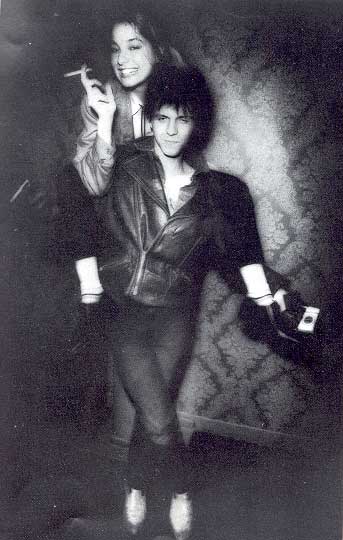
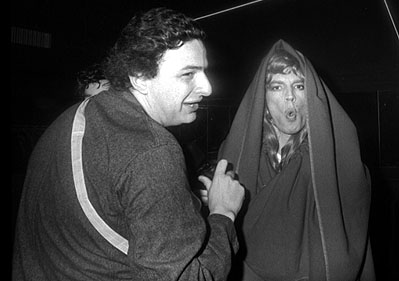
Gay clubs in Paris During the 70s and 80s
LE SEPT / LE PALACE
Le Monde de la Nuit - Les 'Nightclubbers'
tirées du livre de Michel SALOFF COSTE
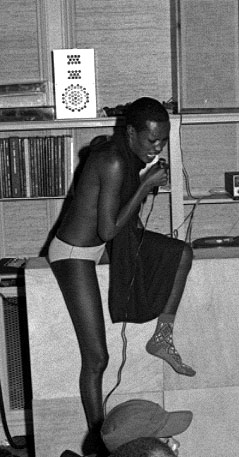
LE PALACEEn 1977, c'est la vague disco et le succès des grandes boîtes comme le Studio 54 à New York ou la Main Bleue à Montreuil. Fabrice cherche alors un endroit plus grand. C'est Michel Guy, ministre de la culture du 1er gouvernement de Giscard et qui lança le festival d'automne qui lui donna l'idée d'acheter le Palace, théâtre du Faubourg Montmartre alors presque à l'abandon. Après d'importants travaux réalisés en un temps record, c'est l'ouverture le 1er mars 1978, avec un show de Grace Jones. Les serveurs sont habillés en rouge et or par Thierry Mugler. Fabrice voulait en faire un lieu ouvert à tous, différent de la rue Sainte Anne, tout en en gardant l'esprit : ce fut une réussite complète. En plus d'être la discothèque la plus courue du moment, élevée au rang de phénomène sociologique, ce fut aussi un endroit où furent données de nombreuses fêtes (Kenzo, Karl Lagerfeld), et aussi une salle de concerts, organisés par Paul Alessandrini puis par Rosebud avec Frédéric Serfati et Assaad Debs.
Autres lieux :
La rue Sainte Anne : le COLONY, le PIMM'S, le BRONX... La MAIN BLEUE, à l'origine une boîte d'immigrés africains à Montreuil et qui est devenue en 77/78 le rendez-vous du Tout Paris noctambule : spectacle surréaliste de toutes ces Rolls garées en pleine zone. Karl Lagerfeld y organisa une soirée Moratoire noir qui fit scandale à cause d'un spectacle de fist fucking. Serge Kruger y fut DJ, avec l'aide de Djemila.
Le BROADWAY MELODY, rue de la Ferronerie, qui était au départ vers 1973 un bar rétro dans une cave tenu par un couple gay, et qui est devenu par la suite le BROAD, plus hard.
L'AVENTURE, avenue Victor Hugo, la boîte très Jet Set de la chanteuse DANI L'APOCALYPSE, rue de Ponthieu, qui méritait bien son nom L'ELYSEE-MATIGNON, très fréquenté par le showbiz, Gainsbourg et Roman Polanski y traînaient tous les soirs - Cafés : le FLORE - Le MABILLON, la terrasse clone de Paris - le DAUPHIN, la rue de Buci
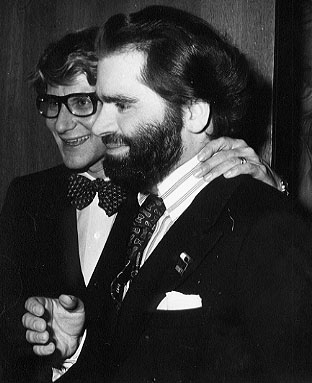
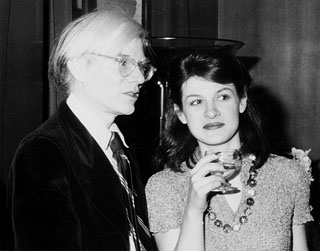
Les habitués : Alain PACADIS - Karl LAGERFELD - Jacques DE BASCHER - Loulou de LA FALAISE et Thadée KLOSSOVSKI - Paloma PICASSO - Joan Juliet BUCK - Antonio LOPEZ - Odette MORLOCK - Bernard MINORET - Le capitaine CAPTA - DOUGLAS, un viking américain hétéro qui tint la porte du Sept en 1974 et fit fantasmer pas mal de folles - Michel GUY - Johnny PIGOZZI - Clio GOLDSMITH - Mick JAGGER -Maria SCHNEIDER - DANI - Frédéric MITTERAND - Andrée PUTMAN - Jean-Paul GOUDE - Grace JONES - JOELLE - MARIE-ANGE - KENZO - Yves SAINT-LAURENT - Pierre BERGE - Joël LE BON - MARILYN - François DYMANT, qui photographiait tout ce petit monde pour 'Le Palace Magazine' - Diane et Babsy OSSUDE - FOC KAN, qui possède un trésor de photos de cette époque - Diane et Minnie de BEAUVEAU-CRAON - Andy WARHOL - - Patrice CALMETTES - Martin FRANCK - FANFAN et FABRICE - JEAN-FRANCOIS - FREDDIE, le Jamaïcain qui faisait partie de 'Sheila B. Devotion' - Yves MOUROUSI - Alice SAPRITCH -Thierry LE LURON - Serge KRUGER et la 'bande au bandeau' - Yves ADRIEN - Philippe MORILLON - Dominique GANGLOFF - TITI ROGNON - DAPHNE - BABETTE - MARIE-HELENE MASSE - Adeline ANDRE - ELYETTE - Marie BELTRAMI - François WIMILLE - David ROCHELINE - Patrick EUDELINE - Thierry ARDISSON, Alain BENOIT et l'équipe de FACADE - L'équipe d''EGOISTE DE LUXE' - Philippe HEURTAULT - Henri FLESH - Dominique FURY - Philippe KROOTCHEY qui fut le DJ des Bains-Douches - Roland BARTHES - PIERRE ET GILLES - Caroline LOEB ("C'est la ouate") - Leslie WINER - Les "Juniors" : Cyrille PUTMAN, Eva IONESCO, Christian LOUBOUTIN, Ann SCOTT -
Le monde des nightclubbers vu par Philippe MORILLON
Eté 77 :Torpeur et punkitude. Au cœur de la métropole, prisonniers de l'asphalte qui fond, 8000000 New Yorkais se voient invités au Grand Trianon.
...Aujourd'hui comme hier dans l'air bruissant de mille choses étaient réunis ici , Maria Niarchos et Ghislaine de Polignac; Gilles Dufour et Jean-C. Pigozzi; Jacqueline de Ribes et Michel de Grèce; Thierry Beherman, Jean-Charles et Jackie de Ravenel; Diane de Beauvau-Craon et Florence Grinda; Georgina Brandolini et Betty Catroux; Marie-Hélène et Guy de Rothschild; Christina Onassis et Andy Warhol; Mick Jagger et Sao Schlumberger; Stavros Niarchos et Inès de la Fressange; Karl Lagerfeld et François Wimille; Nicole Wisniak-Grumbach et Edmée de la Rochefoucauld qui tous passeraient, à n'en point douter, la plus délicieuse des soirées. (Yves Adrien)
j'ai été témoin du mariage de mon amant par Caroline LOEB
"Rose Palace", le documentaire de Colin LEDOUX, avec plusieurs témoignages d'anciens,dont votre serviteur, a été diffusé sur Planete TV en avril 2005
|
Food For Thought: Paris and James Baldwin
Homosexuality in the Time of James Baldwin
later avowed, were not shy about sexual fulfillment. Highly ranked officials in the Nazi regime admitted to holding sexual pleasure in high regard after the war. The conservative messages that were sent during wartime and the truth that came out after the war were extremely different, and this confused many citizens as to what the right path of acceptance was. The natural response to this confusion socially was carefulness and conservativeness.
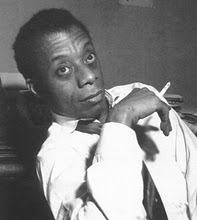
In Paris, homosexuality was openly discussed and openly written about, but people were still being condemned to prison for acts related to homosexuality. As Florence Temagne points out, a law in 1960 called homosexuality “a social plague” (263-264). In French society homosexuality was rebounding after its repression, but its presence was still struggling for acceptance from some heterosexuals. Therefore, it is possible that manycitizens of France accepted James Baldwin during his time there, but it is clear that he must have proceeded with caution because there was still much reservation about homosexuality.